When underground engineering starts to take shape, rotary drills and hydraulic static pile drivers emerge as two distinct "underground sculptors". One carves holes with rotational cutting, the other embeds piles with silent pressure – their differences lie in the core actions of "hole-forming" vs "pile-sinking", and the distinct missions of cast-in-place piles vs precast piles. Wondering how auger drills, long spiral drills, revolving buckets differ from hydraulic static pile drivers? Read on to find out!
Rotary Drills: "Drilled" Underground Channels, All-Formation "Hole-Forming Experts"
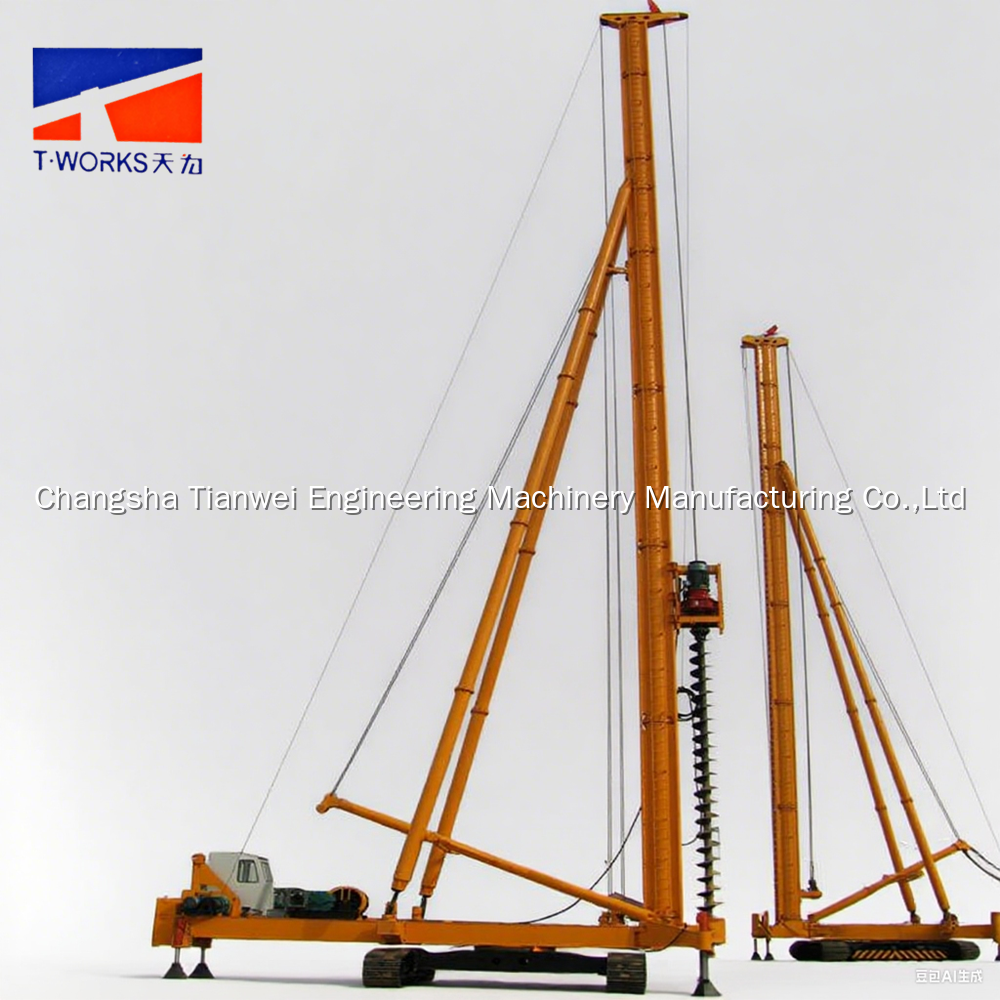
The rotary drill family (auger drills, long spiral drills, revolving buckets) specializes in "rotational cutting to form holes". With powerful rotational driving force, paired with precise lifting and downward pressure, they conquer almost all strata:
- Auger drills excel at grabbing soil and rock, efficiently forming holes in cohesive soil and sand;
- Long spiral drills use spiral blades to transport debris, ideal for quickly forming cast-in-place pile holes;
- Revolving buckets are "experts" in complex formations, handling gravel layers with ease.
The resulting cast-in-place piles are like "underground cast-in-situ columns", requiring on-site placement of steel cages and concrete pouring. Note: Their quality heavily depends on on-site management – from mud wall protection concentration to concrete pouring continuity, every detail affects pile integrity. However, their rock-penetrating capability is exceptional, precisely breaking hard rock, making them a "must-have" for deep foundations in high-rises and bridges.
Hydraulic Static Pile Drivers: "Pressed" Stability, Silent Planters of Precast Piles
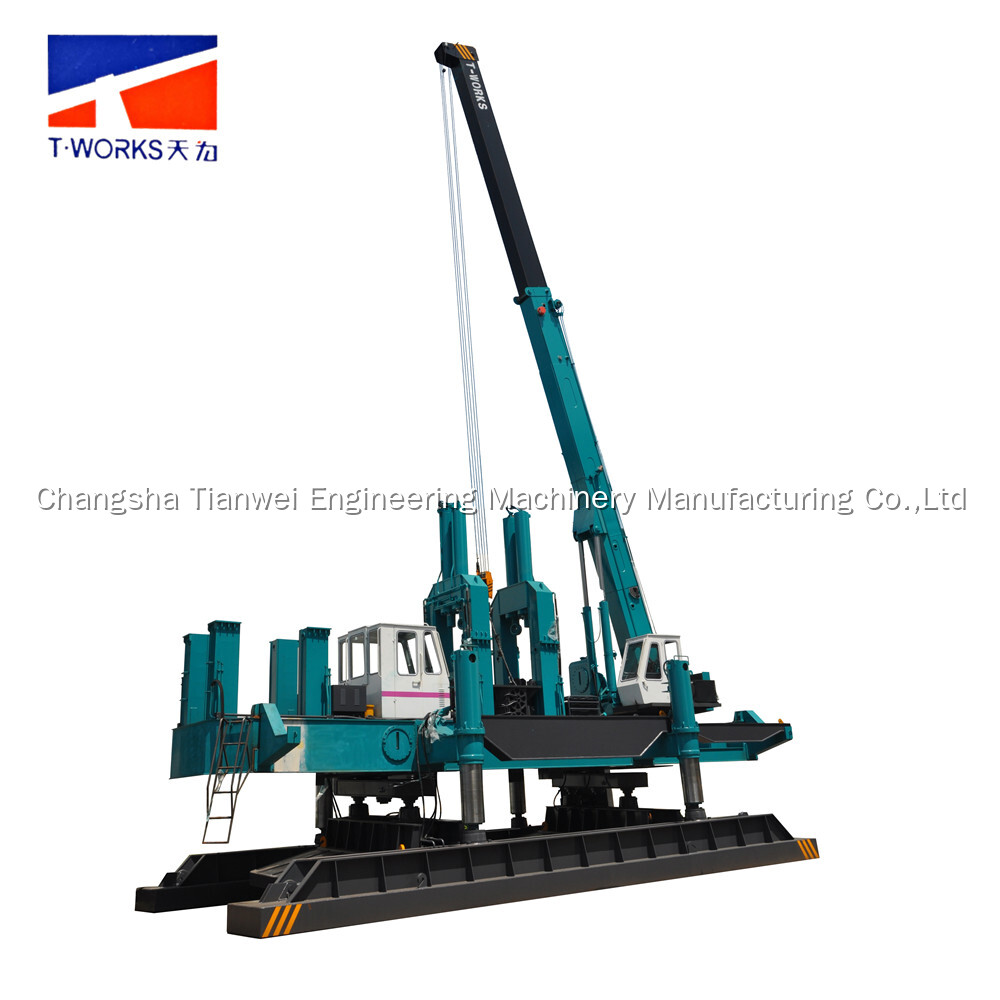
Hydraulic static pile drivers operate on the logic of "static pressure to sink piles": instead of impact or vibration, they transmit hundreds of tons of pressure evenly to precast piles via hydraulic systems, gently embedding them into the ground.
Precast piles are factory-produced with standardized steel ratios and concrete strength, eliminating on-site quality risks (like honeycombing or pile breakage) of cast-in-place piles. Crucially, they operate with low noise and no vibration, making them "environmental-friendly tools" in sensitive areas like residential zones and hospitals. In soft soil and cohesive strata, static pile sinking is far more efficient than hole-forming and pouring – the "press-and-stabilize" feature drastically shortens construction periods.
Core Differences: Hole-Forming vs Pile-Sinking, Cast-in-Place vs Precast
| Comparison Dimension | Rotary Drills (Auger/Long Spiral/Revolving Bucket) | Hydraulic Static Pile Drivers |
|---|
| Core Action | Rotational cutting to form holes | Hydraulic static pressure to sink piles |
| Pile Type | Cast-in-place (on-site pouring) | Precast (factory-produced) |
| Quality Control | Dependent on on-site management | Factory-standardized, more stable |
| Adaptable Strata | All formations (especially rock strata) | Soft soil, cohesive soil, non-hard formations |
| Construction Efficiency | Affected by pouring/curing, longer cycle | Fast pile sinking, no curing wait |
Which to Choose? Depends on Geology, Design & Scenario!
- Complex geology (with rock layers/boulders) or need for large-diameter deep piles? Rotary drills (auger/revolving bucket) are preferred;
- Soft strata, pursuit of efficiency and environmental friendliness? **Hydraulic static pile drivers** are better suited;
- Comprehensive projects? They often "team up": rotary drills handle deep complex strata, while static pile drivers quickly reinforce shallow foundations.
Contact T-WORKS!
Loyalty tailored to global projects, one by one.
忠诚定制,为全球每一个项目量身打造
Whether it’s the "dynamic hole-forming" of rotary drills or the "silent pile-sinking" of hydraulic static pile drivers, both are "invisible guardians" of foundation engineering. Choosing the right equipment based on geological conditions and pile design ensures every pile becomes a "solid foundation" for buildings.
#RotaryDrill #HydraulicStaticPileDriver #AugerDrill #LongSpiralDrill #FoundationConstruction #PrecastPile #CastInPlacePile #EngineeringEquipmentSelection