



Ground pressure is not a fixed value for static pile drivers. Take our T-WORKS 460-ton static pile driver as an example: the total weight of the equipment is approximately 120 tons when unloaded, and can reach 460 tons when fully loaded (including pile body and counterweight). The ground contact part of the static pile driver lies in its traveling mechanism; typically, the ground pressure of the long pontoon is controlled at around 122 kN/m², and that of the short pontoon at around 138 kN/m². This range of variation directly impacts construction safety and efficiency.
The Secret of Static Pile Drivers "Standing Firm": Let’s Talk About Ground Pressure
2025-12-02
×
I. First, Understand: What Exactly Is Ground Pressure?
Many people simply equate ground pressure with "the pressure exerted by the machine on the ground". A more precise definition is: the pressure borne per unit area when the total weight of the static pile driver is evenly distributed over its ground contact area. The calculation formula is "Ground Pressure = Total Weight of Equipment ÷ Ground Contact Area", with the unit usually expressed in "kPa" (kilopascals).
To put it simply, it’s like a person walking on snow: wearing high heels concentrates body weight on the tiny heel tips, resulting in high ground pressure and making it easy to sink into the snow; switching to snow boots distributes weight over a larger sole area, lowering ground pressure and enabling stable walking.
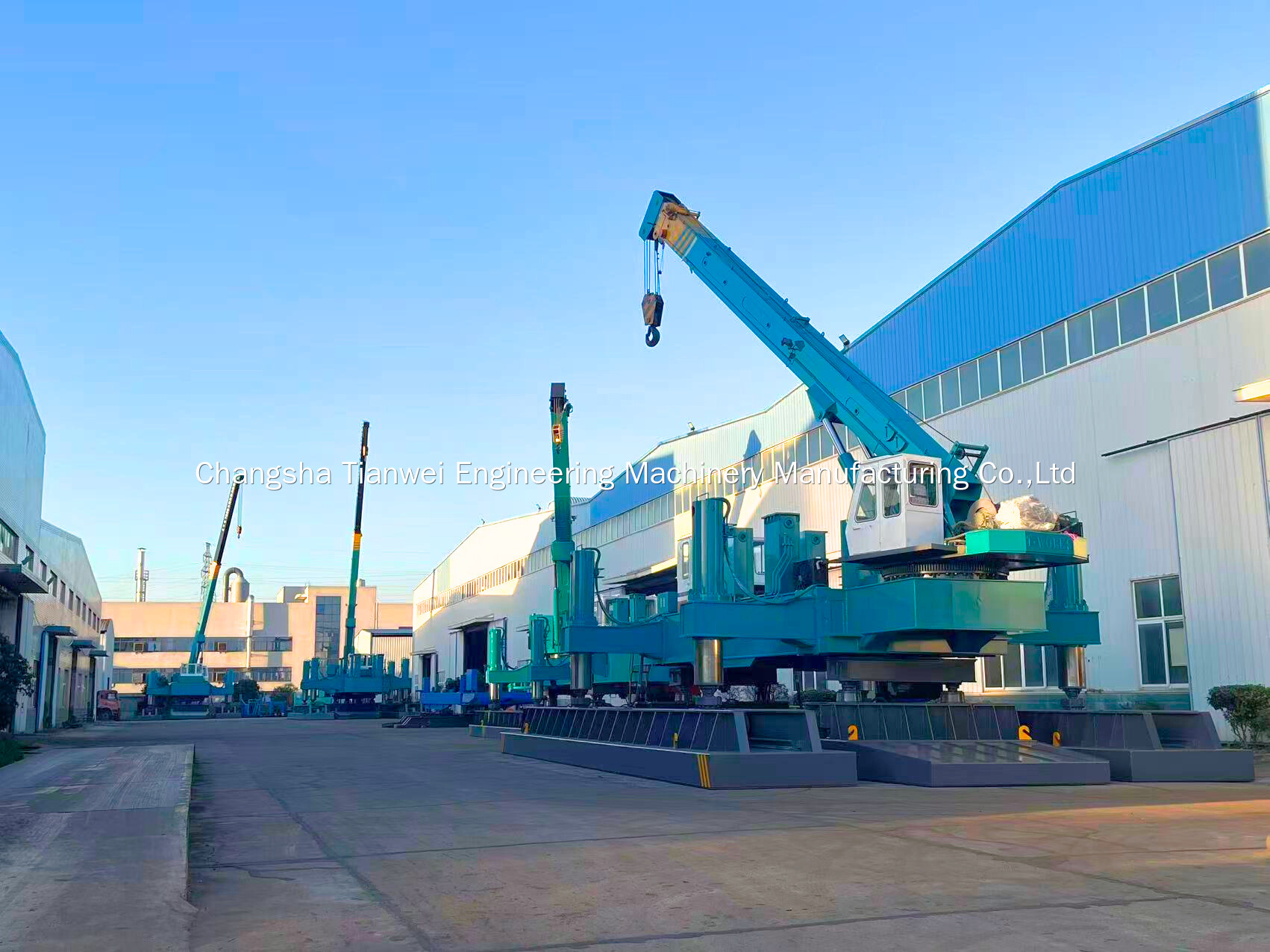
II. Why Must Static Pile Drivers Pay Attention to Ground Pressure?
Over 20 years of pile driver R&D and construction services, we have seen numerous problems caused by ignoring ground pressure: at one construction site, uncompacted backfill soil caused the pile driver’s tracks to sink 30 cm — not only rendering the equipment immovable, but also damaging underground pipelines. During a rainy-season project, excessive ground pressure led to the pile driver slipping in muddy ground, resulting in pile position deviation and rework losses exceeding 100,000 yuan.
Specifically, the impact of ground pressure on static pile driver construction is reflected in two core aspects:
1. Construction Safety: The Bottom Line for Avoiding "Machine Sinking" and "Slipping"
Different types of ground have fixed "load-bearing limits" — backfill soil can withstand approximately 50–80 kPa, compact undisturbed soil around 120–200 kPa, and concrete-paved ground up to over 300 kPa. If the ground pressure of a static pile driver exceeds the load-bearing limit of the ground, track sinking and machine body tilting will occur; in severe cases, equipment overturning may happen, endangering personnel safety.
2. Construction Precision: The "Invisible Guarantee" for Pile Verticality
Static pile drivers require absolute stability of the machine body during pile driving. Uneven ground pressure — for example, excessive ground pressure on one side of the tracks causing sinking — will tilt the machine body. This inevitably leads to verticality deviation of the driven pile, exceeding the specification requirements (usually ≤ 0.5%). Subsequent pile cutting and supplementary piling will increase construction costs.
III. Tips for Construction Teams: Ground Pressure Adjustment Techniques for Daily Construction
As an equipment R&D enterprise, we not only provide reliable equipment, but also aim to help construction teams avoid detours through technical popularization. Combining years of on-site experience, we share two practical tips:
1. "Test First" Before Construction: Understand the load-bearing capacity of the site through geological survey reports, or conduct a simple test — drive an excavator across the site. If track sinking is less than 5 cm, the site is basically suitable for pile driver operation. If sinking is severe, first lay steel plates, gravel, etc., to enhance ground load-bearing capacity.
2. "Reduce Counterweight" When Moving, "Increase Counterweight" When Piling: Remove part of the counterweight when moving the pile driver between sites to reduce ground pressure; reinstall the counterweight for piling upon reaching the pile position, balancing moving safety and construction requirements.
A good piece of equipment must not only be "powerful", but also "stand firm". The core competitiveness of a static pile driver lies not only in the maximum pile driving force it can deliver, but also in its ability to "stand firm" in various complex construction sites — and that is exactly the value of ground pressure.
ReviewsNumber of comments: {{ page.total }}
I want to comment?
{{item.nickname ? (item.nickname.slice(0, 2) + '*****') : item.source === 1 ? 'mall buyer' : '--'}}
{{item.comment_time}}
Review in the {{item.country}}
Reviews
Merchant
{{replyItem.nickname ? (replyItem.nickname.slice(0, 2) + '*****') : replyItem.source === 1 ? 'mall buyer' : '--'}}
{{replyItem.parent_nickname ? (replyItem.parent_nickname.slice(0, 2) + '*****') : '--'}}
{{replyItem.is_merchant_reply === 1 ? replyItem.reply_time : replyItem.comment_time}}
Review in the {{replyItem.country}}
Reviews

No customer reviews
Recommended for you
Get in touch with us
QUICK LINKS
PRODUCTS
CONTACT US
Contacts: Ivy
Tel: +86-150 84873766
Email: ivy@t-works.cc, info@t-works.cc
WhatsApp: +86 15084873766
Address: No.21, Yongyang Road, Liuyang Hi-tech Industrial Development Zone, Changsha, Hunan, China 410323

T-works will provide not only reliable piling machinery products but also excellent and efficient service.
Copyright © 2026 Changsha Tianwei Engineering Machinery Manufacturing Co.,Ltd - www.t-works.cc All Rights Reserved. | Sitemap | Privacy Policy